Cambodia, officially the Kingdom of Cambodia, is a Southeast Asian country bordered by Thailand, Laos, Vietnam and the Gulf of Thailand. Often called the “Kingdom of Wonder,” it draws visitors with Angkor’s temples, colonial towns, tropical islands, rainforests and a culture shaped by Theravada Buddhism and Khmer traditions.
This page summarises the history, landscape and cultural life that form the backdrop to any journey through the country.
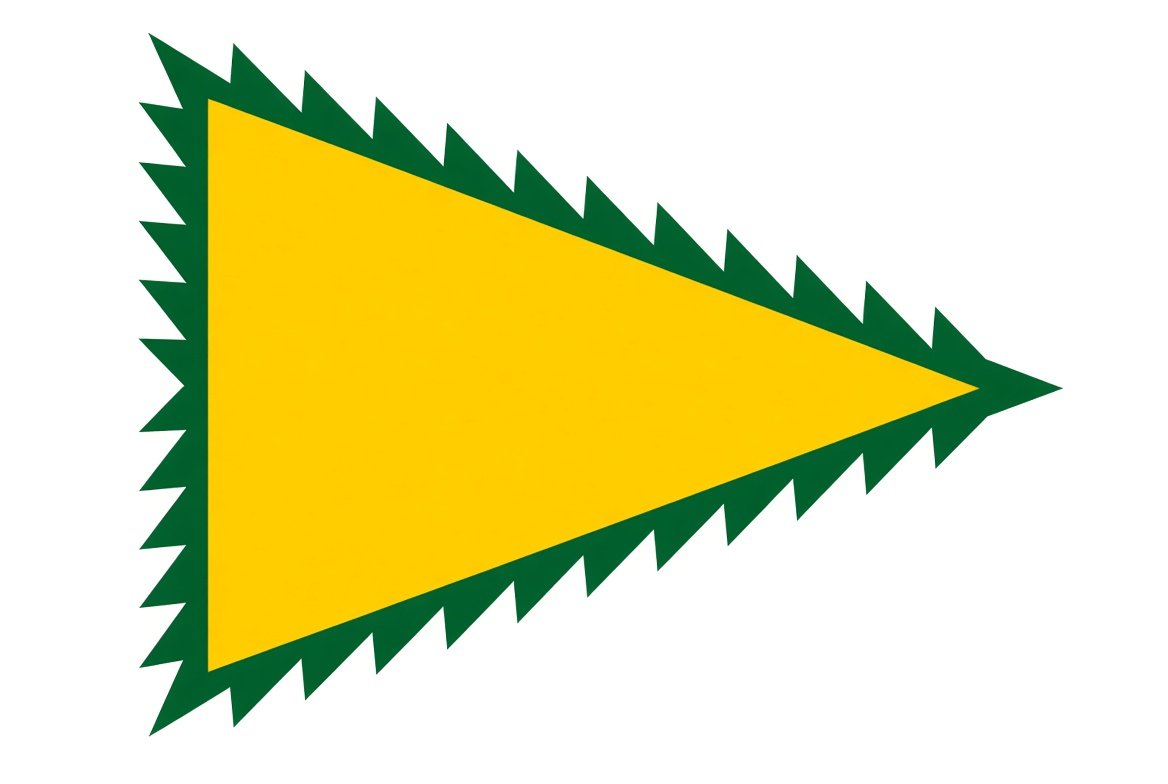
Historical Khmer Empire banner (yellow field with green border)
History
Cambodia’s story spans more than two thousand years — from early river kingdoms to the height of Angkor, periods of decline, colonial rule, independence, tragedy in the late 20th century, and recovery as a modern tourism destination.
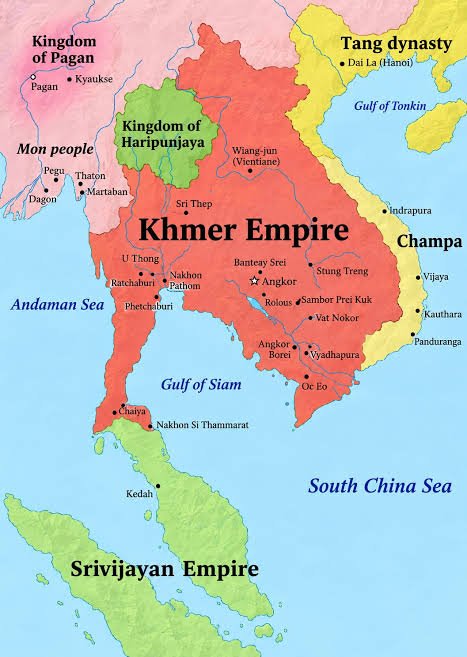
Khmer Empire map — approximate greatest extent (12th–13th centuries)
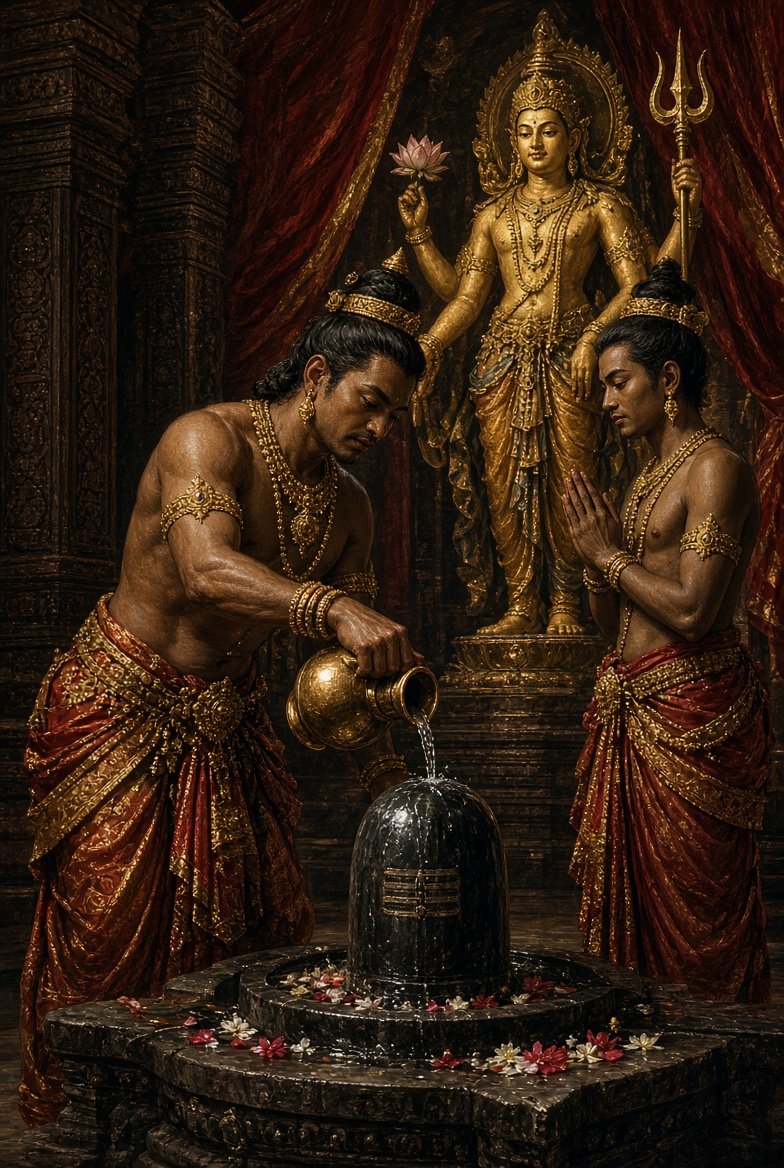
Khmer royalty and sacred ritual from the Angkor era
Historical timeline
Early maritime kingdom in the lower Mekong region, influenced by Indian culture, trade and Hindu-Buddhist ideas. Ports linked China, India and the archipelago.
Successor polities inland along the Mekong and Tonle Sap. Gradual shift toward the political centre that would become Angkor.
Jayavarman II is traditionally credited with unifying the realm and declaring independence from foreign overlordship, founding the Angkorian monarchy.
Capitals at Hariharalaya (Roluos) and later Yasodharapura. Monumental temple-mountains such as Bakong and, later, Pre Rup and East Mebon reflect the devaraja (god-king) cult.
King Suryavarman II builds Angkor Wat as a Hindu temple dedicated to Vishnu. It remains the largest religious monument in the world and the emblem of Cambodia.
Mahayana Buddhist king who expands the empire, builds Angkor Thom, the Bayon (with its famous face towers), Ta Prohm, Preah Khan and an extensive network of roads and rest houses.
Ecological strain, shifting trade, and pressure from neighbouring powers. The court gradually moves toward the Phnom Penh region; Angkor is never fully abandoned but loses primacy.
Capitals at Longvek, then Oudong and Phnom Penh. Cambodia navigates between stronger Siamese and Vietnamese neighbours. Theravada Buddhism becomes firmly established.
France establishes a protectorate. Phnom Penh develops as a colonial capital; Angkor is studied and restored by the École française d’Extrême-Orient. Independence movements grow in the 20th century.
Cambodia gains full independence under King Norodom Sihanouk. A period of relative peace and cultural flourishing follows until the late 1960s.
The monarchy is overthrown; conflict intensifies amid the wider Indochina wars.
Democratic Kampuchea under Pol Pot empties the cities and causes the death of a large part of the population. Sites such as Tuol Sleng and Choeung Ek in Phnom Penh are visited today as memorials.
The regime falls in 1979. A decade of conflict and isolation follows before United Nations-sponsored elections in 1993 and the restoration of the constitutional monarchy.
Political stability returns, Angkor is inscribed as a UNESCO World Heritage Site (1992), and tourism becomes a major part of the economy. Travellers today encounter both the glory of Angkor and the memory of recent history in museums and memorials.
Kings and monuments travellers encounter most often
Suryavarman II
Builder of Angkor Wat (early 12th century). Hindu devotion to Vishnu; the temple later became a Buddhist site.
Jayavarman VII
Mahayana Buddhist monarch behind Angkor Thom, Bayon, Ta Prohm and Preah Khan — many of the most visited temples.
Jayavarman II
Traditional founder of the independent Khmer Empire (c. 802), associated with the sacred mountain cult at Phnom Kulen.
For visitors: Angkor Archaeological Park (Siem Reap), the National Museum and Royal Palace (Phnom Penh), Oudong, and the genocide memorials provide the main historical experiences on a typical trip.
Geography
Cambodia covers about 181,000 km² at the heart of the Indochinese peninsula. Low central plains, the Tonle Sap lake and the Mekong River dominate the interior; mountains and plateaus frame the north, northeast and southwest.
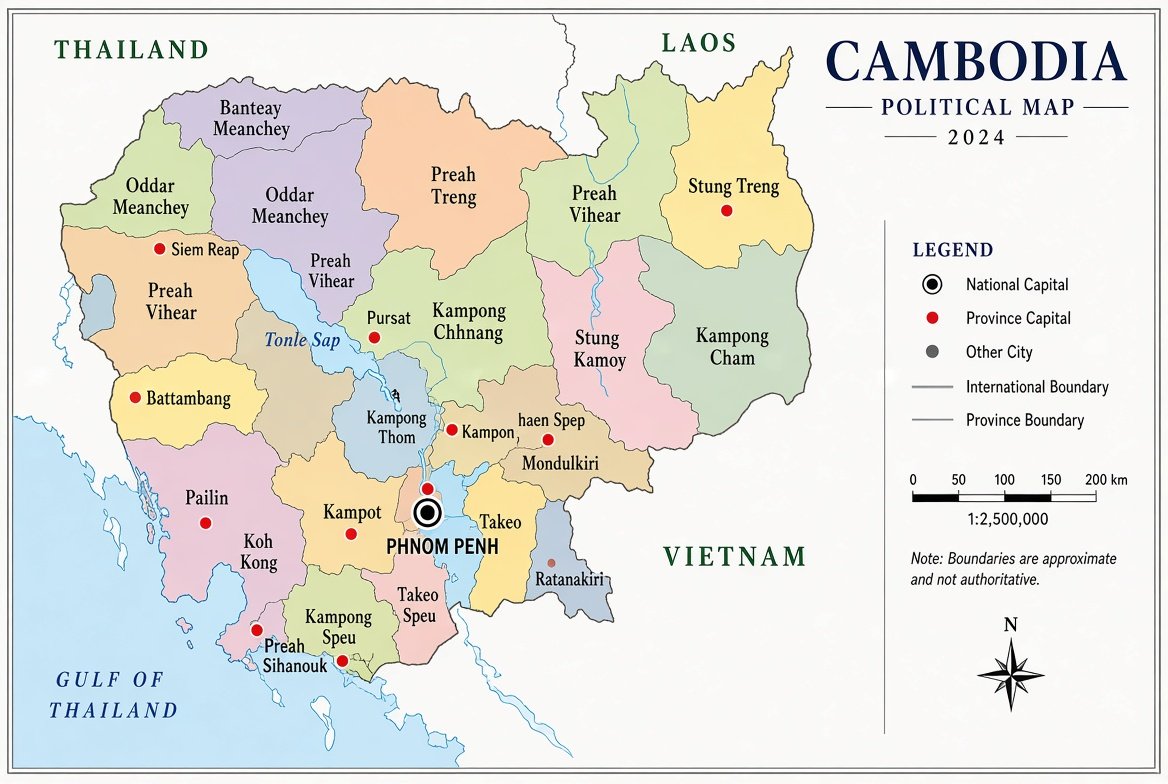
Current map of Cambodia — main cities, Tonle Sap and the Mekong
Tonle Sap
Southeast Asia’s largest freshwater lake. It expands dramatically in the wet season when the Mekong backs up into the lake. Floating villages and bird sanctuaries (such as Prek Toal) are major visitor attractions, usually reached from Siem Reap.
Mekong River
Flows from north to south through Stung Treng, Kratie, Kampong Cham and Phnom Penh. Irrawaddy dolphin watching near Kratie and river life along the banks are popular experiences.
Cardamom & Elephant Mountains
Southwest ranges with rainforest, waterfalls and eco-lodges around Koh Kong and Kampot’s Bokor plateau. Among the most biodiverse areas in mainland Southeast Asia.
Northern & eastern highlands
Dangrek range (Preah Vihear temple), and the cooler plateaus of Mondulkiri and Ratanakiri — waterfalls, coffee, ethnic minority cultures and nature tourism.
Coast
Gulf of Thailand shoreline with Sihanoukville, Kep, Kampot and the islands of Koh Rong and Koh Rong Sanloem — beaches, diving and seafood.
Climate for travellers
Dry season roughly November–April (peak tourism, cooler evenings Dec wet season May–October (lush landscapes, fewer crowds, afternoon rain). Temperatures are tropical year-round.
Main visitor gateways: Phnom Penh (capital), Siem Reap (Angkor), and Sihanoukville (coast and islands).
Religion & Culture
Theravada Buddhism is the religion of the large majority of Cambodians and shapes daily life, festivals, art and the rhythm of the calendar. Hindu-Buddhist heritage from the Angkor period remains visible in temple architecture and classical dance.
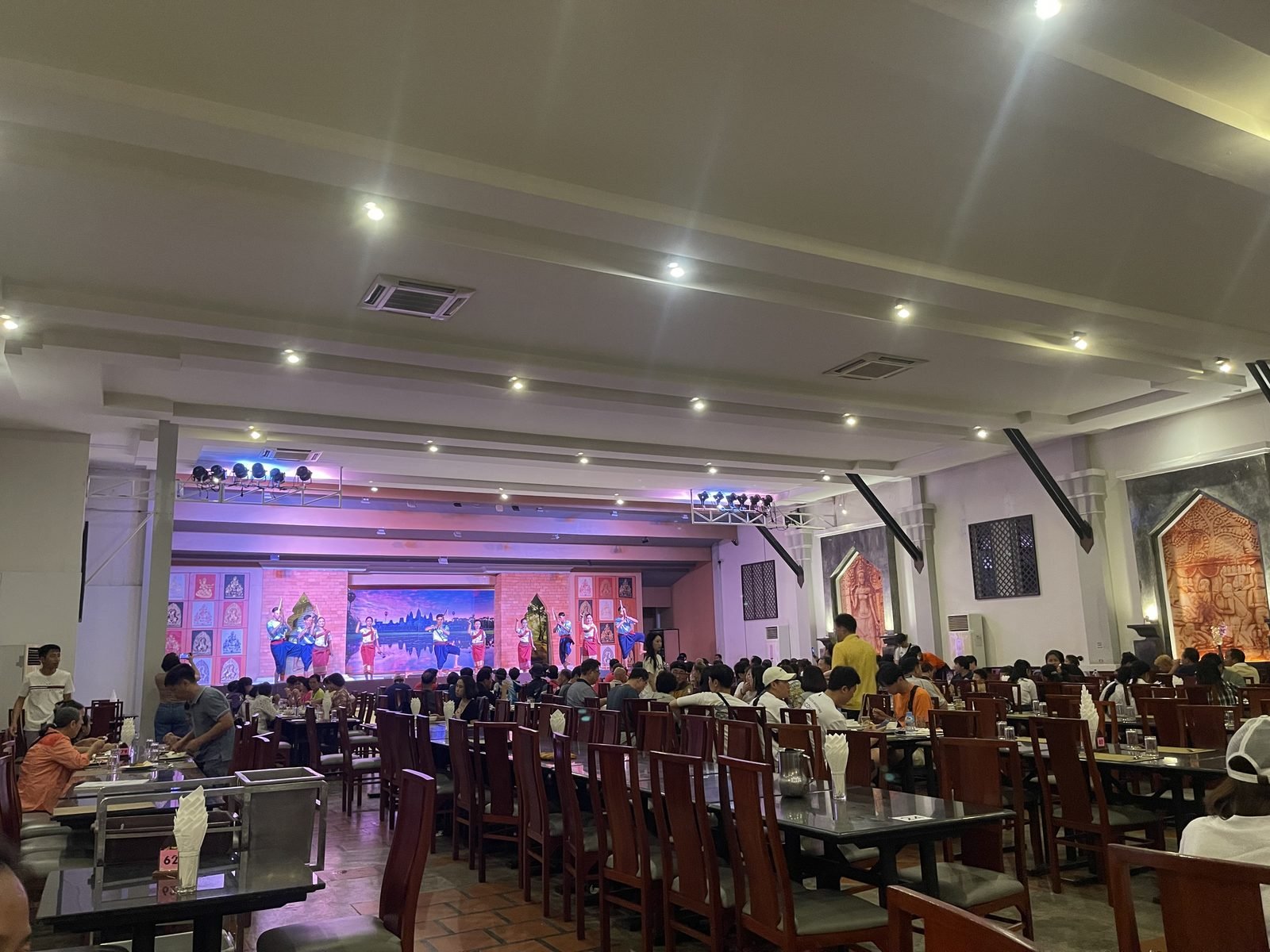
Apsara dance — classical Khmer performance
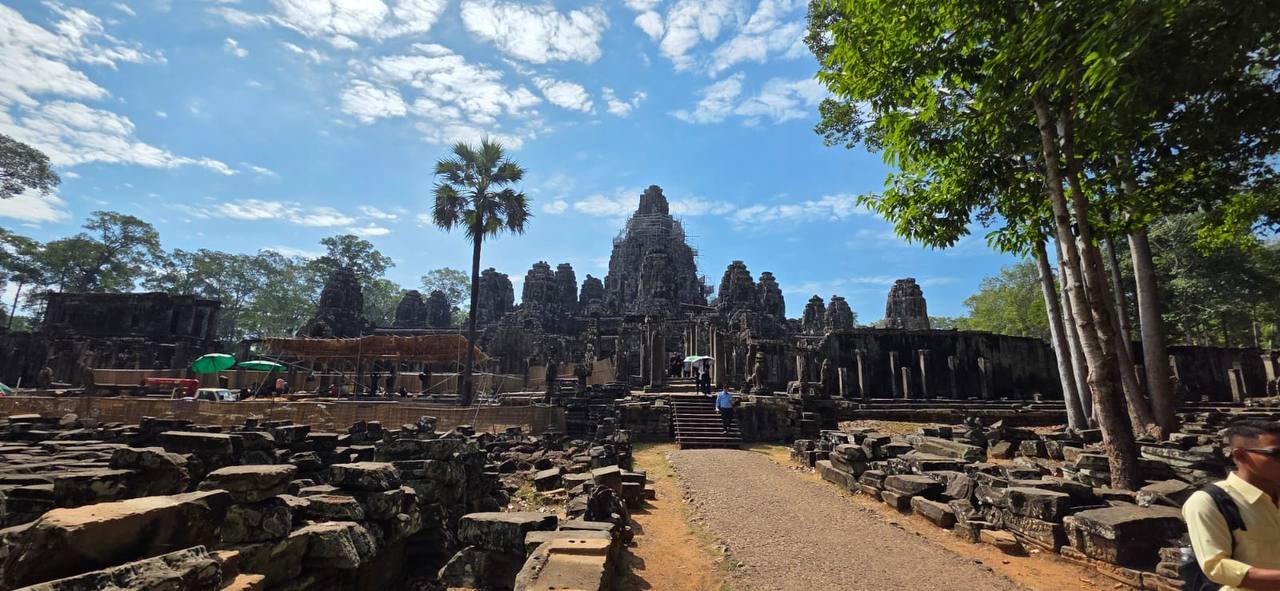
Bayon — smiling faces of the Angkor era
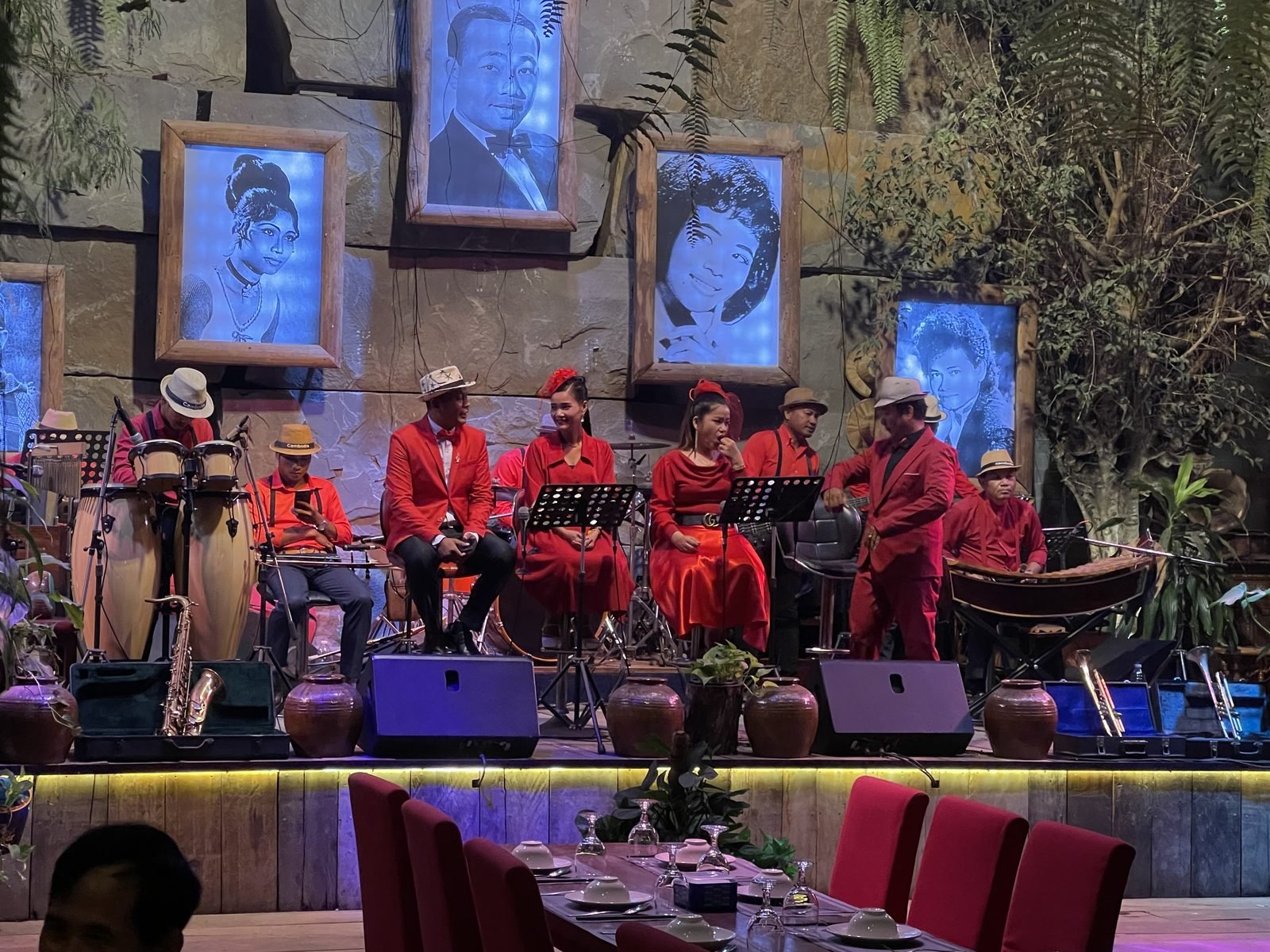
Traditional music and performance
Religion
Theravada Buddhism
Pagodas (wat) are community centres as well as places of worship. Monks in saffron robes are a common sight. Visitors are welcome at most temples if they dress modestly (covered shoulders and knees) and remove shoes before entering shrine halls.
Other faiths & heritage
Small Muslim (Cham), Christian and other communities. Angkor’s temples began as Hindu or Mahayana Buddhist sanctuaries; their iconography still tells those stories for modern visitors.
Cultural highlights for visitors
Apsara & classical dance
Graceful dance rooted in temple art and royal courts. Evening shows in Siem Reap and Phnom Penh are among the most popular cultural experiences.
Music & shadow theatre
Pinpeat ensembles accompany ceremony and dance. Sbek thom (large shadow puppets) dramatise epic stories.
Crafts
Silk weaving (including Silk Island near Phnom Penh), silverwork, wood and stone carving, krama scarves and lacquerware — widely available in markets and workshops.
Cuisine
Balanced sweet, sour, salty and bitter flavours. Signature dishes: fish amok, lok lak, nom banh chok, samlor soups, and Kampot pepper with seafood. Street food and markets are part of the travel experience.
Festivals
Khmer New Year (April), Pchum Ben (ancestor festival, Sep/Oct), and Water Festival (Bon Om Touk) in Phnom Penh (Oct/Nov) are the main events travellers may encounter. Dates follow the lunar calendar.
Etiquette
Modest dress at temples; ask before photographing people; avoid touching monks’ robes (especially for women); feet should not point at sacred images or people. A respectful “sompeah” greeting (palms together) is appreciated.
Government & practical notes
Cambodia is a constitutional monarchy. The capital is Phnom Penh. For travellers, the most relevant points are entry requirements, currency and local regulations.
- Currency: Cambodian riel (KHR); US dollars are widely accepted for tourism services.
- Language: Khmer is the national language; English is common in tourist areas.
- Time zone: ICT (UTC+7).
- Electricity: 230V; plugs vary — a multi-adaptor is useful.
See Travel Info for visas, transport, health and safety guidance for visitors.