Cambodia has one of Southeast Asia’s richest and oldest martial traditions. From the battlefield systems of the Angkor era to modern stadium kickboxing, Khmer martial arts combine striking, grappling, weapons and ritual. Today they are practised as sport, cultural performance and living heritage — authentic expressions of Khmer identity that developed independently within Cambodian culture and history.
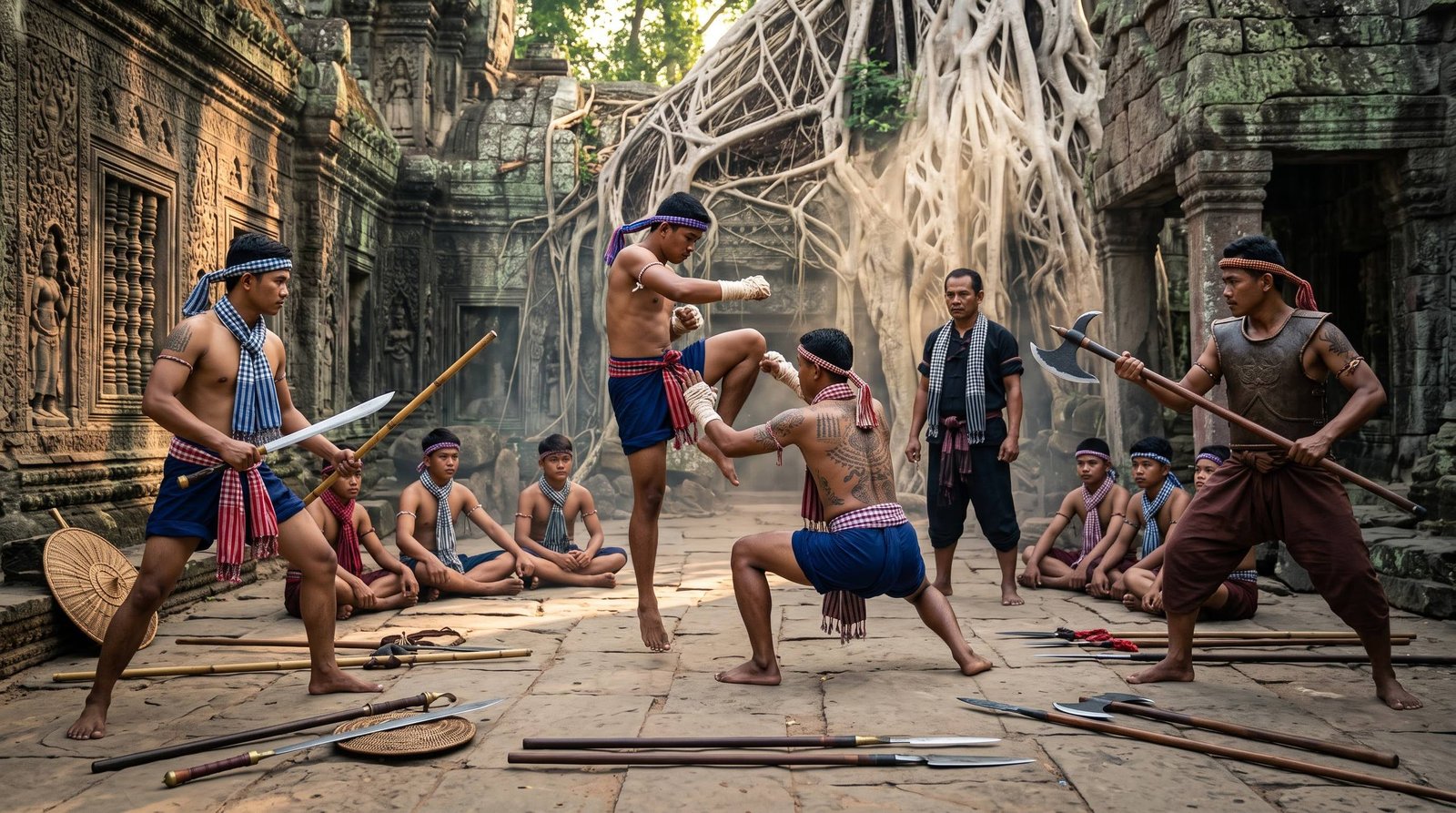
Traditional Cambodian martial arts practice – empty-hand techniques and weapons training in a historic temple setting
Kun Khmer (Pradal Serey) — Cambodian kickboxing
Kun Khmer, also known internationally as Pradal Serey (“free fighting”), is Cambodia’s traditional kickboxing style. Fighters use punches, kicks, elbows and knees in a fast, powerful clinch-heavy game. Matches are held in stadiums in Phnom Penh and provincial towns, and the sport remains deeply popular with Cambodian audiences.
Techniques and character
- All eight “points” of contact: fists, feet, elbows and knees
- Strong emphasis on elbows, knee strikes and clinch work
- Low kicks, round kicks and straight punches delivered with a distinctly Khmer rhythm and defensive style
- Traditional music (often drum and flute) accompanies bouts; fighters perform a pre-fight ritual dance (kun kru / respect to the teacher) and wear a ceremonial headband and armbands
History in brief
Striking arts in the Khmer world are centuries old, depicted in Angkorian reliefs and described in later chronicles. In the modern era, organised Kun Khmer developed in the 20th century as Cambodia’s national kickboxing sport. The sport was severely disrupted during the Khmer Rouge period (1975–1979), when many practitioners and teachers were killed or displaced. From the 1980s and especially from the 1990s onward, Kun Khmer was rebuilt through gyms, national competitions and international exchanges.
Khmer martial culture and identity
Kun Khmer is a distinctly Cambodian martial art with deep roots in Khmer history, culture and the Angkorian battlefield tradition. It features punches, kicks, elbows, knees, clinch work and ritual elements, all practised with a uniquely Khmer rhythm, defensive style, rulesets and national character. Kun Khmer is managed by Cambodian federations and stands as a proud symbol of Cambodian heritage. It continues to grow through national competitions, gyms across the country and increasing international interest.
Visitors can train or watch Kun Khmer in Siem Reap and Phnom Penh, or attend live boxing matches at stadiums and local venues.
Bokator (L’bokator) — ancient Khmer martial art
Bokator (also written Labokator or L’bokator) is an ancient Cambodian martial art that goes far beyond sport kickboxing. It combines striking, grappling, throws, joint locks, ground work and weapons, and includes animal-inspired techniques (lion, elephant, horse, monkey, crocodile and others). The name is often explained as related to “pounding” an enemy, reflecting its battlefield origins.
Techniques and training
- Empty-hand forms: punches, kicks, elbows, knees, headbutts, sweeps and throws
- Clinches and close-range control; submissions and locks
- Animal styles used as teaching frameworks for movement and strategy
- Weapons: staff, sword, spear, bamboo shields and other traditional arms (see below)
- Conditioning, footwork and formal sequences (kbach) passed from teacher to student
History and revival
Bokator is widely regarded as one of the oldest martial systems of the Khmer people, with roots that practitioners link to the Angkor period and earlier. Battlefield skills of Khmer armies would have included both unarmed combat and weapons. Like many cultural practices, Bokator suffered catastrophic loss during the Khmer Rouge years. From the late 20th century, surviving masters and a new generation of teachers began a systematic revival. Schools in Phnom Penh and the provinces now teach Bokator to Cambodians and foreign students; demonstrations appear at cultural festivals; and the art is increasingly presented as intangible cultural heritage.
Cultural meaning
Bokator is not only a fighting method. Training traditionally includes respect for the teacher, ethical conduct and connection to Khmer identity. For many Cambodians, supporting Bokator is part of reclaiming and celebrating pre-modern culture after decades of conflict.
Kbach Kun Boran Khmer — traditional combat forms
Kbach Kun Boran Khmer refers to traditional Khmer combat techniques and fighting forms — the “ancient techniques” of Khmer martial culture. The term covers structured sequences, strategies and body methods that underpin both empty-hand and weapons practice. It overlaps with Bokator and with the technical vocabulary used by Kun Khmer coaches when they teach classical movements.
- Formal patterns and drills that encode defence, offence and body mechanics
- Principles of timing, distance, balance and use of the whole body
- Links to classical dance and gesture: Khmer martial and performance arts share vocabulary of stance, hand position and rhythm
- Transmission through lineage teachers and, increasingly, formal schools and federations
For visitors, short workshops in Kbach Kun Boran or Bokator are sometimes offered in Phnom Penh and Siem Reap through cultural centres and martial arts schools — a deeper alternative to only watching stadium fights.
Khmer traditional weapons
Classical Khmer martial arts include training with traditional weapons. Techniques were developed for warfare and later preserved as cultural practice. Common weapons in the curriculum include:
- Swords — single and double swords; cutting, thrusting and defensive patterns
- Staff / long stick — fundamental training tool for distance, timing and power
- Spear — battlefield weapon with thrusting and sweeping techniques
- Bamboo shields and short weapons — used in paired drills and historical reenactment-style training
- Other arms — depending on the school: knives, clubs and improvised tools historically associated with village and military defence
Weapon forms are practised slowly for precision and at speed for application. In cultural performances, choreographed weapon routines may be shown alongside empty-hand demonstrations. Museums and some heritage sites also display historical Khmer weapons from the Angkor and post-Angkor periods.
Cambodian martial arts: culture, identity and management
Khmer martial arts form an integral part of Cambodian culture and national identity. Kun Khmer is managed and promoted as a national sport through Cambodian federations and stadium competitions, while Bokator and Kbach Kun Boran are preserved and taught as living cultural heritage linked to the Angkor period and earlier battlefield systems. Training emphasises respect for the teacher (kru), ethical conduct and connection to Khmer history.
Cambodian martial systems developed independently within Khmer society. Kun Khmer, Bokator and traditional weapons practice are distinctly Cambodian in technique, ritual, organisation and cultural meaning.
In modern times:
- Cambodia actively promotes Kun Khmer as a national sport and Bokator as intangible cultural heritage, with schools, competitions and revival programmes across the country.
- Management of the arts is handled by Cambodian organisations, masters and cultural institutions.
- The Cambodian perspective stresses the deep, independent roots of Khmer martial culture as a core part of national identity and heritage.
- Visitors are welcome to train, observe and support the living tradition as practised and managed in Cambodia today.
For travellers, the practical takeaway is clear: in Cambodia you experience Kun Khmer as live sport and Bokator / Kbach Kun Boran as traditional martial culture — both authentic expressions of Khmer history, identity and cultural management.
Where visitors can train or watch martial arts
- Siem Reap — training schools and cultural centres offering Kun Khmer and Bokator classes for visitors; martial demonstrations at cultural shows; convenient for temple-area travellers
- Phnom Penh — major stadium Kun Khmer (boxing) matches; established Bokator and Kun Khmer gyms with observation and trial classes for beginners and experienced practitioners
- Watch boxing — live Kun Khmer bouts are regularly held in stadiums in Phnom Penh and selected provincial venues; evening fights are the most common spectator format
- Provincial towns — local training halls and festival-period fights; ask your hotel or a licensed guide for current schedules
Whether you wish to train in Siem Reap or Phnom Penh, or simply watch authentic Cambodian boxing, local organisers and guides can arrange experiences that respect the cultural and technical standards of Khmer martial arts. For broader cultural context see About Cambodia – Culture and Things to Do.